Most people do not decide to pressure wash their driveway on a calm Sunday. They decide the day they slip on the back steps, or when a buyer, a guest or a landlord is about to see the place and the patio looks a shade darker than it should.
Hard surfaces in New England take a beating. Winter brings road salt and sand, spring brings pollen and wet leaves, and humid summers let mold and algae settle into every shaded corner. This guide covers the signs that it is time, the best windows of the year to do it around Greater Boston, how often different surfaces typically need it, and what to watch out for if you are thinking about doing it yourself.
Signs your driveway or patio is ready for a wash
The clearest sign is color. Concrete that has gone gray or blotchy, pavers that have lost their original tone, and brick with a green or black film usually have a layer of organic growth and grime on top. That film is mostly algae, mildew and moss, and it thrives on the north side of the house, under trees and anywhere water sits after rain.
The second sign is grip. Slippery steps and walkways are not just a cosmetic issue, especially for kids, older relatives or tenants walking out in the morning dew. If your patio feels slick when it is damp, the growth is thick enough to matter.
Other signs: oil and rust spots on the driveway where the car parks, dark tannin stains left by fall leaves that sat too long, black streaks near downspouts, and weeds or moss pushing up through paver joints and expansion cracks. One or two of these is normal wear. Three or more usually means a full cleaning will make a visible difference.
The best time of year in New England
Spring is the most popular window, and for good reason. Once nights stay above freezing (usually from mid April onward around Boston), it makes sense to wash away the salt, sand and grit that winter left behind. Salt residue sitting on concrete is not something you want there longer than necessary, and clearing the sand also gets rid of a lot of the material that clogs paver joints.
Early fall is the second good window. After a humid summer, patios and decks often have their heaviest growth of the year, and cleaning in September or early October removes it before leaves pile up and winter locks everything in place. A clean surface also makes it easier to spot cracks or loose pavers you may want to deal with before the freeze.
What to avoid: freezing temperatures. Water left in pores, cracks and joints can freeze overnight, expand and make small damage worse, and a wet surface that turns to ice is a real slip hazard. As a general rule, most pros plan outdoor washing for days when the temperature stays comfortably above freezing through the night.
How often: concrete, pavers, brick and wood decks
There is no single schedule that fits every home, because shade, trees and how much the area is used change everything. A sunny driveway in Milford with no trees overhead stays clean much longer than a shaded patio in Newton under a big maple. As a rough guide:
Concrete driveways and walkways: about once a year, usually in spring. Driveways with heavy car use or regular oil drips may need a touch-up in between.
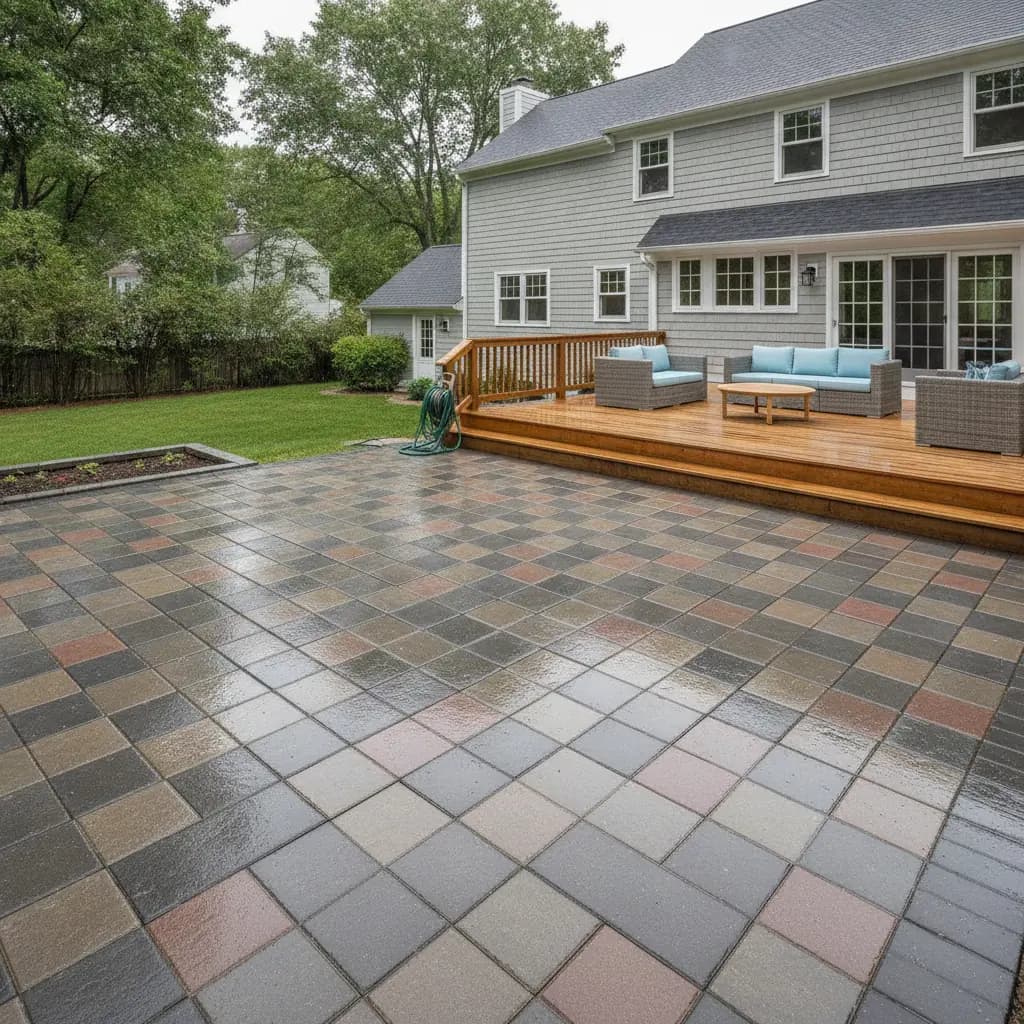
Pavers: every one to two years for the surface. Pavers have joints filled with sand, so the cleaning needs to be done with care, and many homeowners have the joints refilled afterward if a lot of sand came out.
Brick patios and steps: every one to two years. Brick is porous and holds moisture, which is why it tends to turn green quickly in shaded spots. Older brick is softer than it looks and deserves a gentle approach.
Wood decks: about once a year, often in spring or early fall. Wood is the most delicate surface on this list. It can be cleaned well, but it is also the easiest to damage, which is why deck cleaning is usually treated as its own job rather than lumped in with the driveway.
DIY pressure washing: what can go wrong
Renting or buying a pressure washer is easy, and for a small concrete pad it can work out fine. The risks come from treating every surface the same way.
Etching is the most common mistake. Holding the nozzle too close, or using too much pressure on concrete, can leave permanent stripes, swirl marks and a rough, chewed up surface. Once it is etched, no cleaning will make it look even again.
Stripping and splintering are the deck version of the same problem. Too much pressure lifts the soft grain of the wood, leaves it fuzzy and can strip off any stain or sealer you paid for. Brick and older mortar can also lose material if they are hit too hard.
Water where it should not go is the third risk. Blasting straight into paver joints washes out the sand that keeps them locked in place, and spraying toward the house can push water behind siding, under door thresholds and into basement window wells. Add in the noise, the ladder and hose management, and the fact that many people only do this once a year, and it is easy to see why a lot of homeowners decide it is worth having someone else handle it.
What to expect from a professional visit
A good visit starts with a look at the actual surfaces. Concrete, pavers, brick and wood each need a different approach, so before quoting, a pro will usually want to know what you have, roughly how big the area is, and what you are trying to get rid of (green growth, oil, leaf stains, general grime). Photos make this much faster.
On the day, expect the area to be cleared of cars, planters and furniture you want moved, and a plan for where the dirty water will run. Plan on keeping kids and pets inside while the work is happening. Most driveway and patio jobs take a few hours, not a full day, though large or heavily stained areas take longer.
Be realistic about results. Organic growth, dirt and fresh leaf stains usually come off well. Old oil stains that have soaked deep into concrete often lighten a lot but may not disappear completely, and etching from a past DIY job cannot be undone by cleaning. A straight answer about this before the job is a good sign you are talking to the right people.
Getting a quote in Greater Boston
Price depends on the size of the area, the type of surface, how much buildup there is and how easy it is to reach. A two car driveway and a back patio is a very different job from a long walkway, a set of brick steps and a wood deck, so ballpark numbers you see online rarely match your home.
JC Cleaning of Home handles pressure washing for driveways, walkways, patios, decks and steps, along with exterior house cleaning for siding, outside windows, doors and trim, across Boston and nearby towns like Newton, Brockton and Milford. Estimates are free and there is no visit fee.
The easiest way to start: snap a few photos of your driveway, patio or deck and send them on WhatsApp to (857) 258-6271, or fill out the free quote form. We will take a look and get back to you with an estimate, in English or Portuguese.
Want a price for your home?
Send a few photos on WhatsApp and we reply with a free estimate. No visit fee.